

Uncategorized
Chronic Pain Relief in Macon, GA: A Complete Guide to Getting Your Life Back
7th August 2026
If you’ve been living with pain that just won’t quit — day after day, month after month — you already know how much it can steal from your life. It changes how you sleep, how you work, how you play with your kids or grandkids, and even how you feel about the future. If you’re searching for real answers to chronic pain in Macon, GA, you’re in the right place. At Phillips Chiropractic, we’ve spent more than 20 years helping people across Middle Georgia move better, hurt less, and get back to the things that matter.
This guide breaks down what chronic pain actually is, why it happens, and how a drug-free, non-surgical chiropractic approach may help you find lasting relief — not just a temporary mask over the problem.
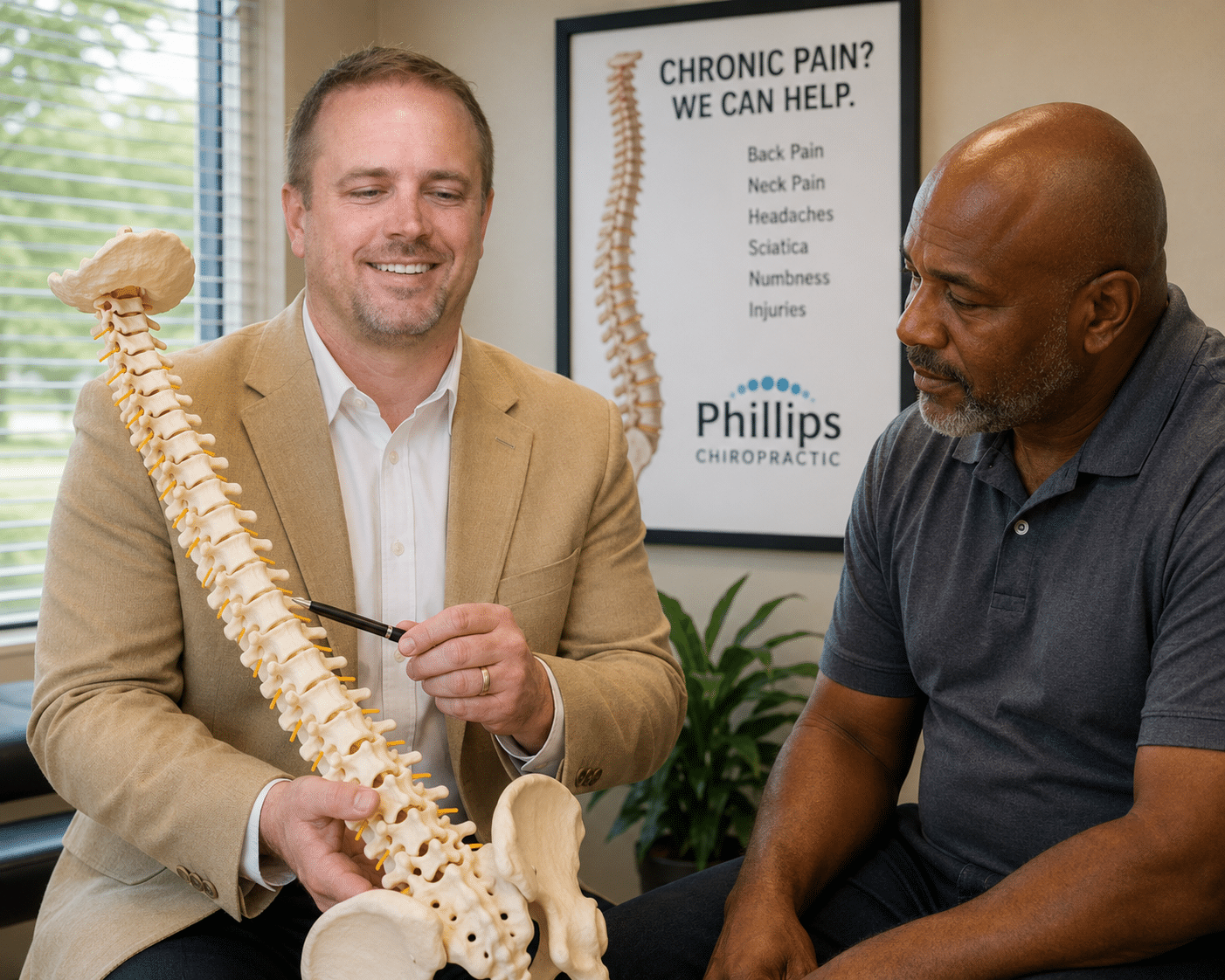
Image suggestion: A warm, natural-light photo of Dr. Phillips reviewing a spine model with a patient, both looking at the model together. Alt text: “Chiropractor explaining the spine to a chronic pain patient in Macon, GA.”
What Is Chronic Pain, Exactly?
Most of us are familiar with acute pain — the sharp, immediate signal you feel when you stub your toe, pull a muscle, or sprain an ankle. Acute pain has a clear purpose: it tells you something is wrong so you’ll protect the injured area while it heals. Once the tissue repairs itself, the pain fades.
Chronic pain is different. By definition, chronic pain is pain that persists for 12 weeks or longer — often long after the original injury or illness has healed. Sometimes it lingers because of an ongoing condition like arthritis. Other times, the original injury is gone but the nervous system has essentially “learned” the pain and keeps firing those signals anyway. Either way, the result is the same: a pain problem that has become a condition in its own right.
According to the Centers for Disease Control and Prevention, chronic pain is one of the most common reasons adults seek medical care in the United States, and it’s closely linked to reduced quality of life, difficulty working, anxiety, and depression. In other words, chronic pain is never “just” physical — it touches every part of your life.
Common types of chronic pain we see in Macon
- Low back and neck pain — by far the most common, often tied to posture, old injuries, or degenerative changes
- Joint pain — knees, shoulders, hips, and hands, frequently related to arthritis or overuse
- Nerve-related pain — burning, tingling, or shooting pain from conditions like neuropathy or sciatica
- Headaches and migraines — including tension-type headaches that originate in the neck
- Widespread pain — such as the body-wide aching seen in fibromyalgia
- Post-injury pain — lingering discomfort after a car accident, work injury, or sports injury
Why Does Chronic Pain Happen?
Understanding why you hurt is the first step toward doing something about it. Chronic pain usually develops through one or more of the following pathways.
1. Unresolved musculoskeletal problems
When a joint isn’t moving the way it should — because of a past injury, poor posture, or the wear-and-tear of daily life — the surrounding muscles compensate. Over time, that compensation creates tension, inflammation, and restricted motion. The body enters a frustrating loop: restricted joints lead to muscle guarding, muscle guarding leads to more restriction, and the cycle feeds itself. Breaking that cycle is one of the core goals of chiropractic care.
2. Nervous system sensitization
Your spine houses and protects your spinal cord — the information superhighway between your brain and the rest of your body. When pain signals fire over and over for weeks or months, the nervous system can become sensitized, meaning it amplifies pain signals and even generates pain in response to things that shouldn’t hurt at all. This is a big part of why chronic pain can feel out of proportion to any obvious injury, and why simply “resting” often isn’t enough to fix it.
3. Inflammation and lifestyle factors
Ongoing inflammation — driven by things like poor sleep, high stress, a sedentary lifestyle, or diet — can keep pain simmering in the background. Addressing these factors is part of a whole-person approach to lasting relief.
4. Degenerative changes
As we age, discs lose hydration, cartilage wears down, and joints can develop arthritis. These changes are normal, but they can contribute to chronic pain when combined with poor movement patterns or old injuries. The good news: even when we can’t reverse degeneration, we can often improve how those joints move and how much they hurt.
The Problem With “Just Mask It” Approaches
For many people, the first stop for chronic pain is a bottle of pain relievers. Medication has its place, and we’re grateful for it in the right circumstances — but for long-term pain, a “mask it and hope” strategy has real downsides:
- It doesn’t fix the cause. Pain relievers change how you perceive pain; they don’t restore proper joint motion or calm a sensitized nervous system.
- Tolerance and side effects. Over time, some medications require higher doses for the same effect, and long-term use of certain drugs carries serious risks.
- The pain comes back. When the medication wears off, the underlying problem is still there.
That’s why national guidelines increasingly recommend non-drug, conservative therapies as a first-line approach for common chronic pain conditions like low back pain. The American Chiropractic Association and research summarized by the National Center for Complementary and Integrative Health both point to spinal manipulation and other conservative care as reasonable, evidence-informed options for many people with chronic musculoskeletal pain.
How Chiropractic Care Helps With Chronic Pain
Chiropractic care is built around a simple but powerful idea: when your spine and joints move properly and your nervous system is free from interference, your body is better able to function and heal. Here’s how that translates into relief for chronic pain.
Restoring proper joint motion
The hallmark of chiropractic care is the adjustment — a precise, controlled movement applied to a restricted joint to restore its normal motion. When a joint that’s been “stuck” starts moving correctly again, several things happen: muscle tension around it eases, circulation improves, and the constant stream of irritation signals to the nervous system calms down. For many patients, this is the moment the pain cycle finally starts to break.
Reducing pressure on nerves
When spinal joints are misaligned or discs are compressed, nearby nerves can become irritated — producing pain that may radiate into the arms, legs, or elsewhere. By improving spinal alignment and motion, chiropractic care aims to reduce that irritation, which is why so many patients with sciatica, nerve pain, and radiating symptoms find relief.
Calming the whole system
Because chiropractic care works directly with the spine and nervous system, many patients notice benefits beyond the treated area — better sleep, less overall tension, and improved mobility. When your body isn’t constantly bracing against pain, it can finally relax and recover.
Image suggestion: A close-up of a gentle, hands-on spinal adjustment in a clean, modern treatment room. Alt text: “Gentle chiropractic adjustment for chronic pain relief in Macon.”
A personalized, whole-person plan
There’s no such thing as a one-size-fits-all chronic pain patient, so there’s no one-size-fits-all plan. At Phillips Chiropractic, Dr. Phillips takes the time to understand your history, examine how you move, and identify the specific drivers of your pain. Your plan may combine several tools, such as:
- Spinal and extremity adjustments to restore motion
- Soft-tissue therapy to release tight, guarded muscles
- Therapeutic exercises and stretches to build strength and stability so relief lasts
- Posture and ergonomic guidance for work and home
- Lifestyle recommendations around movement, sleep, and stress that support healing
What to Expect at Your First Visit
If you’ve never seen a chiropractor for chronic pain, the unknown can feel intimidating. Here’s what a first visit at Phillips Chiropractic typically looks like so you can walk in knowing what to expect.
A thorough consultation
We start by listening. You’ll share your pain history — when it started, what makes it better or worse, how it affects your daily life, and what you’ve already tried. This conversation matters, because the details of your story often point directly to the cause.
A hands-on examination
Next comes a physical evaluation. We assess your posture, range of motion, muscle tone, and the specific joints involved. In some cases, imaging or additional testing may be recommended to get a complete picture. The goal is a clear, accurate understanding of what’s driving your pain — not guesswork.
A clear explanation and plan
One of the things patients tell us they appreciate most is that we explain what we find. You’ll leave your first visit understanding what’s contributing to your pain and what a realistic path to relief looks like — including how many visits it may take and what you can do at home to speed things along.
Care at your pace
Chiropractic adjustments are generally gentle, and Dr. Phillips tailors his techniques to your comfort level, age, and condition. If you’re nervous about “cracking,” let us know — there are lower-force techniques available, and your comfort always comes first.
Chronic Pain and Everyday Life in Middle Georgia
Chronic pain doesn’t happen in a vacuum. The way we live and work in Macon and the surrounding communities plays a real role. Long commutes, desk jobs, physically demanding trades, weekend yard work in the Georgia heat, and time spent hunched over phones all add up. Small, repeated stresses on the spine — day after day, year after year — are often the quiet contributors behind “I don’t even know how I hurt it” pain.
That’s why our approach goes beyond the treatment room. We help you identify and change the daily habits that keep your pain alive, whether that’s how you sit at your workstation, how you lift, or how you sleep. Relief that lasts comes from combining hands-on care with smarter daily movement.
Real Relief Is Possible — Even If You’ve Tried Everything
If you’ve bounced from one solution to the next without lasting results, it’s easy to lose hope. But here’s what two decades of practice has taught us: many people who thought they’d “just have to live with it” find meaningful relief once someone finally addresses the root cause instead of the symptoms. Chronic pain is complex, and no honest provider can promise a miracle — but a thorough, personalized, conservative approach helps a great many people reclaim function and comfort they thought were gone for good.
You don’t have to keep organizing your life around your pain. There is a path forward, and it starts with a conversation.
Frequently Asked Questions About Chronic Pain
How long does it take to feel relief from chiropractic care? It varies. Some patients feel noticeably better after the first few visits, while chronic, long-standing problems often take longer because we’re retraining tissues and calming a sensitized nervous system. During your evaluation, we’ll give you a realistic timeline based on your specific situation.
Is chiropractic care safe for chronic pain? For most people, chiropractic care is a safe, conservative option — which is exactly why it’s recommended as a first-line approach for many common pain conditions. Dr. Phillips reviews your health history and tailors techniques to your needs. If your condition requires medical co-management, we’ll tell you.
Do I need a referral to see a chiropractor in Macon? No. You can schedule directly with our office. We accept most insurance plans, including VA benefits and attorney liens, and same-day appointments are often available.
Can chiropractic care help if my pain is from arthritis or a “worn-out” joint? Often, yes. While we can’t reverse degeneration, improving how a joint moves and reducing the muscle tension around it can meaningfully lower pain and improve function. Many of our joint pain patients fall into this category.
What if I’m nervous about being adjusted? That’s completely normal, and we’ll never push you past your comfort level. Let us know, and we’ll use gentle, low-force techniques and walk you through everything before we do it.
Take the First Step Toward a Pain-Free Life in Macon
You’ve read the guide — now let’s talk about your pain. Dr. Phillips and the team at Phillips Chiropractic have helped thousands of Middle Georgia residents get back to living, and we’d be honored to help you too. We serve Macon, Gray, Forsyth, Warner Robins, and the surrounding communities, we accept most insurance, and same-day appointments are frequently available.
Ready to stop living around your pain? Contact us today to schedule your appointment or call (478) 475-4131. Relief could be closer than you think.