

Uncategorized
Whiplash and Neck Pain After a Car Accident in Macon, GA
10th August 2026
You were in a car accident, walked away feeling mostly okay, and figured you got lucky. Then, a day or two later, your neck stiffens up, your head starts pounding, and turning to check your blind spot suddenly hurts. If that sounds familiar, you may be experiencing whiplash — one of the most common and most under-treated car accident injuries. If you’re dealing with whiplash or neck pain after a crash in Macon, GA, prompt care matters. Phillips Chiropractic has helped Middle Georgia accident victims recover from whiplash for more than 20 years.
This guide explains what whiplash is, why its symptoms are so often delayed, and how chiropractic care helps you heal.
What Is Whiplash?
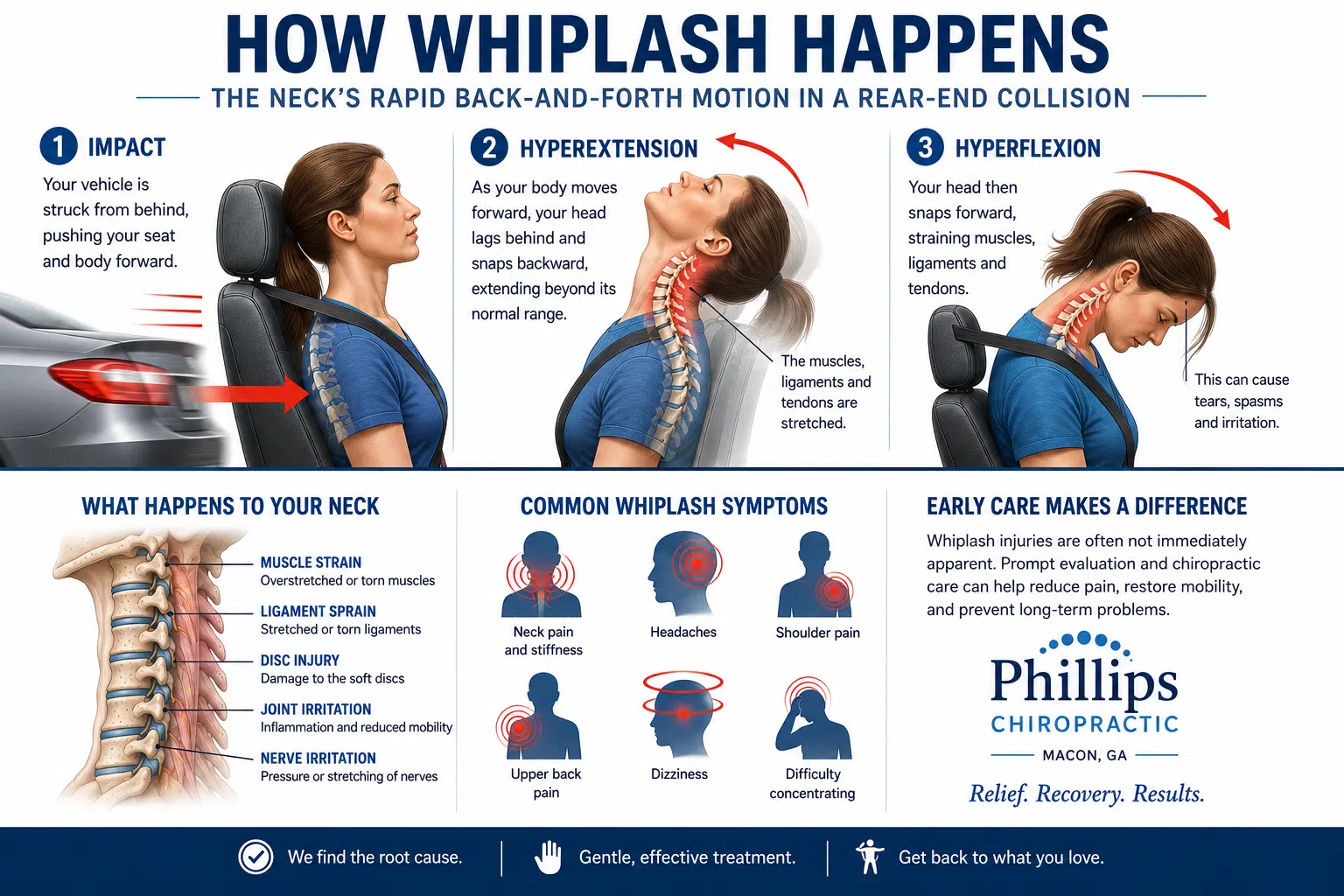
Whiplash is a neck injury caused by a rapid, forceful back-and-forth motion of the head — like the crack of a whip. It happens most often in rear-end car collisions, when the sudden impact throws your head backward and then forward faster than your neck’s muscles and ligaments can handle. That violent motion strains and sometimes tears the soft tissues of the neck: the muscles, ligaments, tendons, and the discs and joints of the cervical spine.
Importantly, whiplash can occur even in low-speed collisions. You don’t need a dramatic, high-speed crash to be injured — the forces involved in even a minor fender-bender can be enough. The Mayo Clinic describes whiplash as a common result of rear-end auto accidents, and notes that symptoms can take time to appear.
Why Whiplash Symptoms Are Often Delayed
This is the single most important thing to understand about whiplash: you can feel fine right after the accident and develop symptoms hours or days later. There are two big reasons for this.
First, the adrenaline and stress hormones that flood your body during a crash are powerful natural painkillers. They can mask injury symptoms completely in the immediate aftermath. As they wear off over the following hours and days, the pain and stiffness set in.
Second, soft-tissue injuries like whiplash involve inflammation that builds gradually. The full extent of the injury often isn’t felt until the inflammatory response develops.
This delay is exactly why you should never assume you’re uninjured just because you feel okay at the scene. Getting evaluated promptly — even without symptoms — is the smart move.
Symptoms of Whiplash
Whiplash symptoms can range from mild to severe and may include:
- Neck pain and stiffness
- Reduced range of motion — difficulty turning your head
- Headaches, often starting at the base of the skull
- Shoulder, upper back, or arm pain
- Tingling or numbness in the arms
- Dizziness or fatigue
- Difficulty concentrating or sleeping
Image suggestion: A gentle cervical range-of-motion examination. Alt text: “Chiropractor evaluating neck range of motion for whiplash in Macon, GA.”
If you experience symptoms like severe pain, significant weakness, or numbness, seek prompt evaluation — and for any red-flag symptoms after a crash, seek emergency care right away.
How Chiropractic Care Helps Whiplash and Neck Pain
Whiplash is fundamentally a musculoskeletal injury to the neck — which makes it a natural fit for chiropractic care. Here’s how we help.
Restoring proper neck motion
Whiplash often leaves the joints of the cervical spine restricted and the surrounding muscles tight and guarding. Gentle, careful adjustments and mobilization help restore normal motion, which reduces pain and stiffness and helps break the cycle of muscle guarding.
Easing soft-tissue injury
Soft-tissue therapy helps address the strained, inflamed muscles and ligaments at the heart of a whiplash injury, supporting circulation and healing.
Preventing chronic neck pain
This is crucial: untreated whiplash frequently becomes a chronic problem, with neck pain and headaches that can linger for months or years. Prompt, proper care significantly improves your chances of healing fully rather than living with lasting pain.
Documentation for your claim
Because whiplash so often results from car accidents, documentation matters. We keep clear, objective records of your injuries, treatment, and progress — important if you’re filing a claim or working with an attorney. This connects closely with our auto accident and personal injury care.
A personalized recovery plan
Your plan is tailored to the severity of your injury and may include gentle adjustments, soft-tissue therapy, therapeutic exercises to rebuild neck strength and flexibility, and guidance on posture and activity as you heal.
What to Do If You Have Neck Pain After a Crash
- Seek emergency care for severe pain, numbness, weakness, or any red-flag symptoms.
- Get evaluated promptly — within a few days of the accident, even if symptoms are mild or you feel okay.
- Document your symptoms as they develop, along with your appointments.
- Notify your insurance and, if relevant, your attorney.
- Follow through on care. Whiplash heals best with consistent, proper treatment — and gaps in care can slow recovery and complicate a claim.
The National Highway Traffic Safety Administration offers additional information on crash injuries and safety.
Frequently Asked Questions About Whiplash
How soon after an accident do whiplash symptoms appear? Often within hours to a few days, as adrenaline fades and inflammation builds. That’s why prompt evaluation is smart even if you feel fine at first.
Can whiplash heal on its own? Mild cases sometimes improve on their own, but many don’t — and untreated whiplash can become chronic. Prompt, proper care improves your odds of a full recovery.
Is chiropractic care safe for whiplash? For most people, gentle chiropractic care is a safe, conservative, and effective approach to whiplash. Dr. Phillips tailors techniques to your injury and comfort, and screens for anything requiring medical referral.
How long does whiplash take to heal? It varies with severity. Many people recover within weeks to a few months with proper care; more severe cases take longer. We’ll give you a realistic timeline.
Will insurance or an attorney lien cover my care? Often, yes — through your coverage, the at-fault driver’s, or an attorney lien. We’ll help you understand your options.
Neck Pain After an Accident? Don’t Wait
Whiplash is far too easy to shrug off — until it becomes a chronic, daily problem. If you’ve been in a car accident in Macon, get your neck evaluated promptly, even if the pain hasn’t fully set in. Phillips Chiropractic serves Macon, Gray, Forsyth, Warner Robins, and all of Middle Georgia, and we accept insurance and attorney liens.
Neck pain or stiffness after a crash? Contact us today to get evaluated or call (478) 475-4131. Early care is the key to a full recovery.
This article is for general educational purposes and is not legal or medical advice. Seek immediate medical attention for severe symptoms, and consult a qualified provider about your specific situation.
Uncategorized
Back Pain Relief in Macon, GA: Drug-Free Solutions That Address the Cause
10th August 2026
Back pain is one of those problems almost everyone experiences at some point — and one of the most disruptive. It can make it hard to work, sleep, exercise, or even get comfortable on the couch. If back pain is wearing you down in Macon, GA, here’s the encouraging news: for the vast majority of people, back pain responds well to conservative, drug-free care that addresses the cause rather than just masking the symptoms. Phillips Chiropractic has helped Middle Georgia residents find lasting back pain relief for more than 20 years.
This guide explains why your back hurts, what you can do about it, and how chiropractic care fits into a smart, conservative approach.
Why Back Pain Is So Common
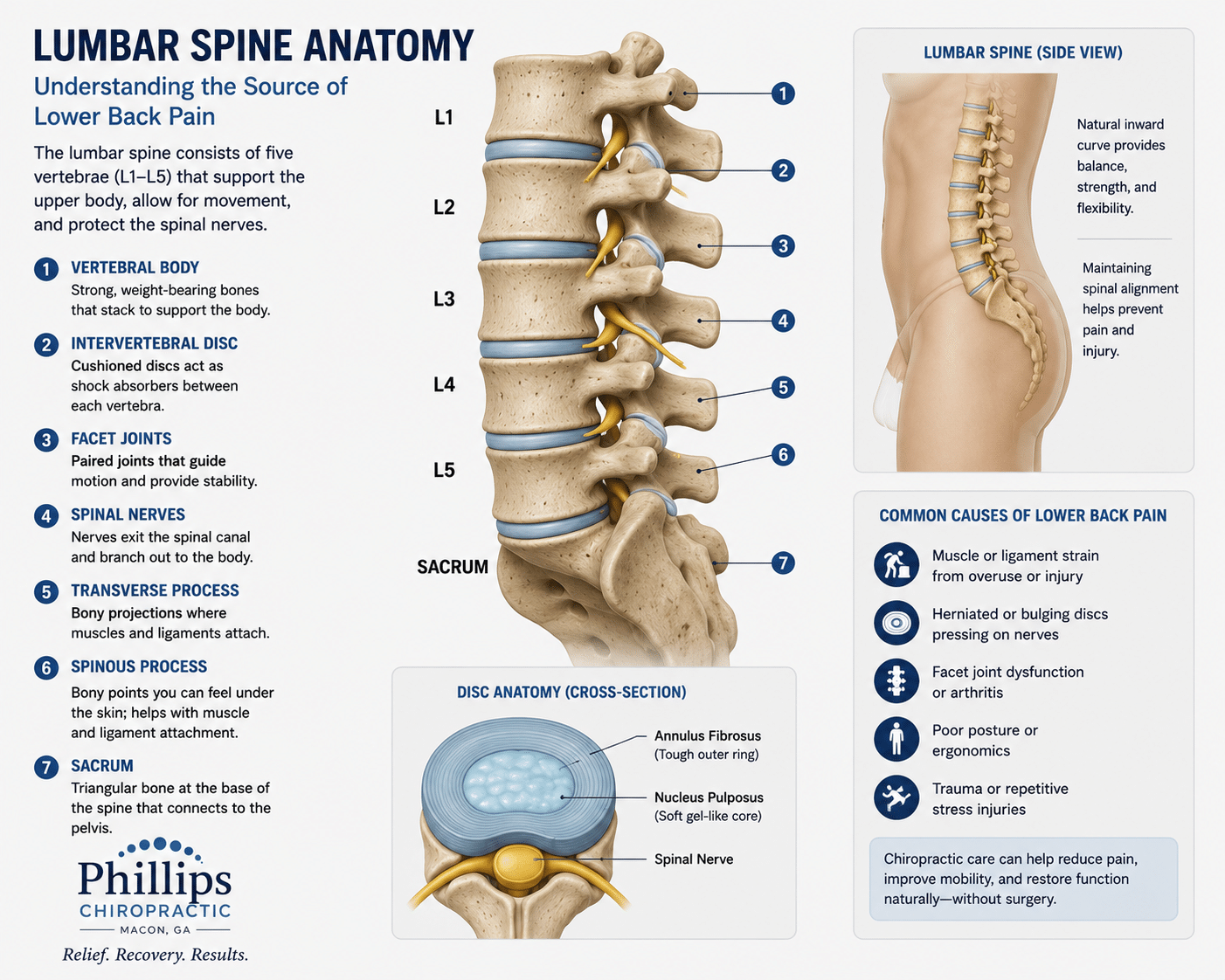
Your spine is an engineering marvel — strong enough to keep you upright, flexible enough to let you bend and twist, and responsible for protecting your spinal cord. But that same complexity makes it vulnerable. Decades of sitting, lifting, poor posture, old injuries, and the simple wear-and-tear of life all take a toll.
Most back pain is mechanical, meaning it comes from the way the spine and its supporting muscles and joints are moving (or not moving) — not from a dangerous underlying disease. That’s actually good news, because mechanical back pain often responds very well to conservative care.
Common Causes of Back Pain
- Muscle strain — from lifting, twisting, or overdoing it
- Poor posture — especially from long hours at a desk or on a phone
- Spinal misalignment and restricted joint motion
- Herniated or bulging discs — which can press on nerves
- Sciatica — nerve pain radiating from the low back down the leg (see our sciatica article)
- Degenerative changes — normal age-related wear in discs and joints
- Injuries — from accidents, sports, or work
The American Chiropractic Association and the National Institute of Arthritis and Musculoskeletal and Skin Diseases both note that back pain is one of the leading reasons people miss work and seek care — and that conservative, non-drug approaches are appropriate first-line options for most cases.
Why “Just Rest and Take a Pill” Often Isn’t Enough
The old advice for back pain was bed rest and painkillers. We now know that’s usually the wrong approach for common back pain. Extended rest can actually slow recovery by allowing muscles to weaken and stiffen, and medication only masks the pain while the underlying mechanical problem remains. National guidelines increasingly recommend non-drug therapies first — including spinal manipulation, movement, and exercise — for most cases of low back pain.
Image suggestion: A simple desk-posture / ergonomics graphic showing good vs. poor sitting posture. Alt text: “Good vs. poor posture for preventing back pain.”
How Chiropractic Care Relieves Back Pain
Chiropractic care is one of the most well-established conservative approaches for back pain, and it’s what we do every day.
Restoring proper spinal motion
The core of chiropractic care is the adjustment — restoring normal motion to spinal joints that have become restricted. When those joints move properly again, muscle tension eases, nerve irritation decreases, and the pain cycle begins to break. Many patients feel meaningful relief as their spine starts moving the way it should.
Relieving nerve pressure
When a disc or misaligned joint irritates a nerve, pain can radiate into the buttock and leg — the classic sciatica pattern. By improving alignment and motion, chiropractic care aims to reduce that pressure and calm the radiating pain.
Easing muscle tension
Back pain almost always involves tight, guarding muscles. Soft-tissue therapy and improved joint motion help those muscles relax and support the spine properly.
Building lasting relief
Real, lasting relief isn’t just about feeling better today — it’s about keeping the pain from coming back. That’s why your plan includes strengthening and mobility exercises, plus posture and ergonomic guidance, so your spine is better supported going forward. For ongoing spinal health, many patients also benefit from our wellness care approach.
What to Expect at Your Visit
At Phillips Chiropractic, we start by listening to your history, then examine your posture, movement, and the specific joints and muscles involved. Dr. Phillips explains what’s driving your pain and builds a personalized plan — including realistic expectations and what you can do at home. Adjustments are tailored to your comfort, age, and condition, with gentle, low-force options available.
When Back Pain Needs More Than Conservative Care
Most back pain is mechanical and responds well to conservative care — but some warning signs warrant prompt medical attention. Seek immediate care if your back pain comes with:
- Loss of bowel or bladder control
- Progressive numbness or weakness in the legs
- Pain following a major trauma like a serious fall or car accident
- Fever, unexplained weight loss, or pain that’s severe and unrelenting at night
Part of a thorough evaluation is recognizing these “red flags.” If we ever see signs your condition needs a physician’s involvement, we’ll tell you and help you get the right care.
Frequently Asked Questions About Back Pain
How long does it take chiropractic care to help back pain? Many patients feel relief within the first few visits, though chronic or long-standing back pain usually takes longer. We’ll give you a realistic timeline at your evaluation.
Is chiropractic care safe for back pain? For most people, it’s a safe, well-established, conservative option — which is why it’s recommended as a first-line approach for common low back pain. We screen for the rare cases that need medical referral.
Can chiropractic care help a herniated disc or sciatica? Often, yes. Many patients with disc-related pain and sciatica find relief through conservative chiropractic care. We’ll assess your specific situation and set realistic expectations.
Should I rest or stay active with back pain? For most common back pain, gentle movement beats extended bed rest. We’ll guide you on safe activity as you recover.
Do you accept insurance? Yes — most insurance plans, including VA benefits, with same-day appointments often available.
Stop Letting Back Pain Run Your Life
You don’t have to reach for another pill or resign yourself to a bad back. With conservative, personalized care that targets the cause, most people find real, lasting relief. Phillips Chiropractic serves Macon, Gray, Forsyth, Warner Robins, and all of Middle Georgia.
Ready to get your back — and your life — back? Contact us today to schedule an appointment or call (478) 475-4131.
This article is for general educational purposes and is not a substitute for professional medical advice, diagnosis, or treatment. Seek prompt medical care for the warning signs described above.

Uncategorized
Sports Injury Chiropractor in Macon, GA: Recover Faster and Prevent Re-Injury
10th August 2026
Whether you’re a high school athlete, a weekend warrior on the softball field, a dedicated runner, or someone who just loves staying active, a sports injury can bring it all to a frustrating halt. The good news: with the right care, most athletes not only recover — they come back stronger and less prone to re-injury. If you’re dealing with a sports injury in Macon, GA, chiropractic care can be a valuable part of getting you safely back in the game. Phillips Chiropractic has helped active Middle Georgia residents recover for more than 20 years.
This guide covers the most common sports injuries, how chiropractic care supports recovery and performance, and how to reduce your risk of getting hurt again.
Common Sports Injuries
Sports injuries generally fall into two categories: acute injuries from a specific incident (a fall, collision, or sudden movement) and overuse injuries that build up gradually from repetitive stress. Common examples include:
- Sprains and strains — the most common sports injuries, affecting ligaments and muscles
- Back and neck injuries — from impact, twisting, or repetitive loading
- Shoulder injuries — including rotator-cuff strain, common in throwing and overhead sports
- Knee injuries — from pivoting, jumping, and running
- Tendonitis and overuse injuries — like runner’s knee, tennis elbow, and shin splints
- Joint pain — related to repetitive impact (see our joint pain guide)
Why Athletes Choose Chiropractic Care
Chiropractic care has become a staple in sports at every level, from youth leagues to the pros. Here’s why.
Faster, more complete recovery
By restoring proper joint motion, easing muscle tension, and supporting healthy tissue function, chiropractic care can help injuries heal more completely — reducing the risk that a nagging problem lingers or comes back. The American Chiropractic Association highlights the role of chiropractic care in athletic recovery and performance.
Drug-free treatment
Athletes often prefer to avoid masking pain with medication, especially when they want to understand and truly heal an injury rather than push through it. Chiropractic care addresses the underlying mechanics.
Better biomechanics and performance
Here’s the part athletes love: care isn’t only about fixing what’s broken. When your spine, pelvis, and joints move well and your body is properly aligned, you move more efficiently — which can support better performance and lower injury risk. The OrthoInfo resource from the American Academy of Orthopaedic Surgeons is a great companion resource on sports injury basics.
Injury prevention
Perhaps the biggest long-term benefit: identifying and correcting the movement imbalances and restrictions that set you up for injury in the first place. Prevention is always better than another trip to the sidelines.
How We Help Athletes at Phillips Chiropractic
Your plan is tailored to your sport, your injury, and your goals, and may include:
- Adjustments and joint mobilization to restore proper motion
- Soft-tissue therapy to address tight or injured muscles
- Rehabilitation exercises to rebuild strength, stability, and flexibility
- Movement and biomechanics guidance to correct the patterns that led to injury
- A safe return-to-activity plan so you don’t rush back and re-injure yourself
The goal is always the same: get you back to your sport safely, and help you stay there.
Preventing Sports Injuries
Whether you’re returning from an injury or just want to stay healthy, these fundamentals go a long way:
- Warm up properly before activity and cool down afterward
- Build strength and flexibility in the muscles that support your sport
- Progress gradually — most overuse injuries come from doing too much, too soon
- Use proper technique and equipment, including good footwear
- Listen to your body — pain is a signal, not something to push through
- Stay consistent with recovery — rest, hydration, and sleep matter
- Address small issues early before they become big ones
The CDC offers helpful, evidence-based guidance on physical activity and injury prevention worth bookmarking.
Frequently Asked Questions
Do I need to be a “serious” athlete to benefit? Not at all. Weekend warriors, recreational runners, and anyone who stays active can benefit from sports-focused chiropractic care — both for recovery and for staying injury-free.
When should I see someone about a sports injury? Don’t push through pain that persists, worsens, or limits your movement. Early evaluation often means a faster, fuller recovery. For serious injuries — significant swelling, inability to bear weight, or a joint that looks deformed — seek medical care right away.
Can chiropractic care improve my performance, not just fix injuries? Many athletes find that better joint motion and alignment help them move more efficiently. While no one can promise specific performance gains, improved mobility and reduced injury risk are meaningful advantages.
How soon can I get back to my sport? It depends on the injury. We’ll build a safe return-to-activity plan and give you a realistic timeline — rushing back is the fastest route to re-injury.
Do you accept insurance? Yes — most insurance plans, including VA benefits, and same-day appointments when available.
Get Back in the Game — Schedule Your Visit
Don’t let a sports injury keep you on the sidelines longer than necessary — and don’t risk re-injury by coming back too soon. Phillips Chiropractic helps active Middle Georgia residents recover and stay healthy. We serve Macon, Gray, Forsyth, Warner Robins, and the surrounding area.
Ready to get back to what you love? Contact us today to schedule an appointment or call (478) 475-4131. Let’s get you moving at full strength again.
Uncategorized
Auto Accident Chiropractor in Macon, GA: What to Do After a Car Crash
10th August 2026
The moments after a car accident are a blur — the adrenaline, the shock, the racing thoughts. And in that rush, one dangerous assumption is easy to make: “I feel fine, so I must be okay.” The truth is that many serious crash injuries, especially whiplash and soft-tissue damage, don’t show their full symptoms until hours or days later. If you’ve been in a car accident in Macon, GA, seeing an auto accident chiropractor promptly is one of the smartest things you can do for both your health and any injury claim. Phillips Chiropractic has helped Middle Georgia crash victims recover for over 20 years.
This guide walks you through the injuries car accidents cause, why quick care matters, and exactly what to do after a crash.
Why Car Accident Injuries Are So Easy to Miss
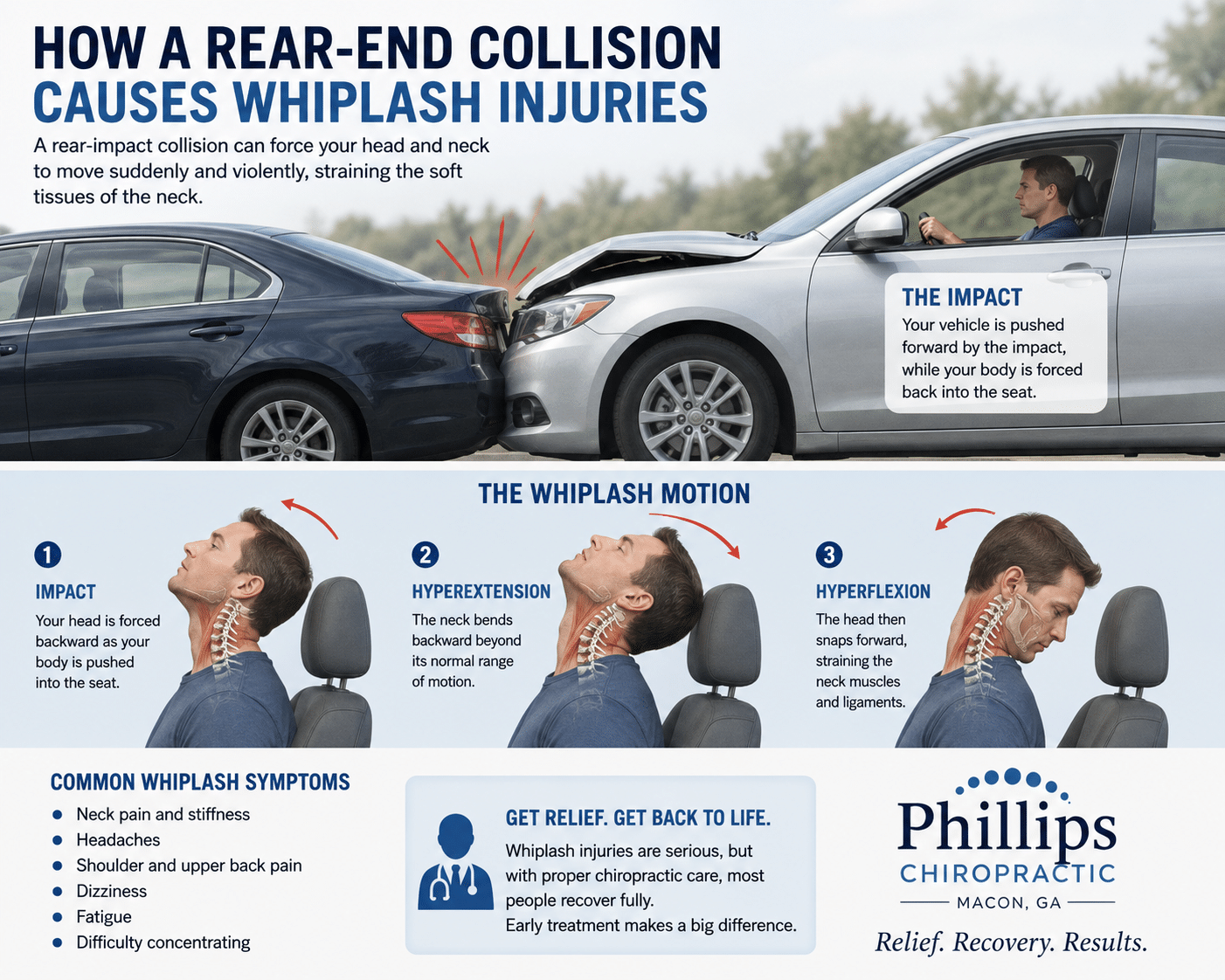
During a collision, your body is subjected to forces it was never designed to absorb — even at low speeds. But in the immediate aftermath, your body floods with adrenaline and endorphins that mask pain. That’s why so many people walk away from a crash feeling “shaken but okay,” only to wake up the next morning barely able to turn their neck.
Even a low-speed fender-bender can generate enough force to injure the delicate soft tissues of the neck and spine. The absence of pain at the scene does not mean the absence of injury — it often just means the adrenaline hasn’t worn off yet.
Common Car Accident Injuries
- Whiplash — the rapid back-and-forth “whip” of the neck, straining muscles and ligaments (learn more in our whiplash guide)
- Neck and back pain — from spinal misalignment and soft-tissue strain
- Soft-tissue injuries — strains and sprains of muscles and ligaments
- Herniated or bulging discs — which can pinch nerves and cause radiating pain
- Headaches — often originating from neck injuries
- Shoulder and knee injuries — from bracing against the impact
- Nerve pain — tingling, numbness, or shooting pain into the arms or legs
The National Highway Traffic Safety Administration and the Mayo Clinic both note how common — and how easily overlooked — these injuries are, particularly whiplash.
Why See a Chiropractor After a Car Accident?
Most car accident injuries are musculoskeletal — precisely what chiropractic care is designed to address. Here’s why crash victims turn to us.
Early detection of hidden injuries
We perform a thorough evaluation to find the injuries that aren’t obvious — the soft-tissue strains, spinal misalignments, and early nerve irritation that can quietly worsen if ignored. Catching them early is the key to a fuller recovery.
Drug-free, non-surgical healing
Rather than simply masking pain with medication, chiropractic care restores proper motion to injured joints, eases muscle tension, and supports natural healing. For many crash injuries, this conservative approach is exactly what’s recommended first.
Image suggestion: A gentle cervical (neck) range-of-motion examination after an accident. Alt text: “Chiropractic neck evaluation after a car accident in Macon, GA.”
Preventing chronic pain
Untreated whiplash and soft-tissue injuries have a nasty habit of becoming long-term problems. Prompt, proper care dramatically improves your odds of healing fully instead of living with lingering pain for years.
Documentation for your claim
If you’re filing an insurance claim or working with an attorney, our detailed records of your injuries, treatment, and progress are often essential. This overlaps closely with the personal injury side of accident care.
What to Do After a Car Accident in Macon
- Ensure safety and call 911 if anyone is hurt. Get a police report.
- Exchange information with the other driver and gather witness details.
- Document the scene with photos of the vehicles, damage, and surroundings.
- Seek medical evaluation promptly — even if you feel fine. See an auto accident chiropractor or physician within a few days.
- Notify your insurance company.
- Keep records of everything — symptoms, appointments, and expenses.
- Follow through on care. Consistency protects both your recovery and your claim.
The single most important takeaway: don’t wait to be evaluated. Getting checked within a few days — even without obvious pain — protects your health and creates the early documentation that connects your injuries to the crash.
Insurance, Liens, and Payment
Worried about how to pay for care after a wreck? We work with most insurance plans and accept attorney liens, so in qualifying cases you can get the treatment you need now and handle payment as part of your settlement later. We’re experienced with the paperwork and communication that accident claims require, so you can focus on healing.
Frequently Asked Questions
How soon after a car accident should I see a chiropractor? As soon as possible — ideally within a few days, even if you feel fine. Early care catches hidden injuries and creates the documentation that links them to the crash.
I don’t have pain yet. Should I still get checked? Yes. Adrenaline masks pain, and whiplash symptoms are frequently delayed. A prompt evaluation is smart insurance for your health.
Can chiropractic care help with whiplash? Yes — whiplash is one of the most common injuries we treat. Restoring proper neck motion and easing soft-tissue strain is core chiropractic work. See our dedicated whiplash guide.
Will my insurance or the at-fault driver cover it? Often, yes — through your coverage, the at-fault party’s, or an attorney lien. We’ll help you understand your options.
Do I need a referral? No. You can schedule directly with our office.
Been in a Crash? Get Checked Today
Don’t gamble with your health by waiting to see if the pain shows up. A prompt evaluation after a car accident can be the difference between a full recovery and months of chronic pain. Phillips Chiropractic serves Macon, Gray, Forsyth, Warner Robins, and all of Middle Georgia, and we work with insurance and attorney liens.
Recently in an accident? Contact us today to get evaluated or call (478) 475-4131. The sooner we see you, the better your recovery.
Uncategorized
Personal Injury Chiropractor in Macon, GA: Treatment and Documentation After an Accident
10th August 2026
An accident can change everything in an instant. One moment you’re going about your day; the next you’re hurt, shaken, and facing a maze of medical appointments, insurance calls, and legal questions. If you’ve been injured in an accident in Macon, GA, a personal injury chiropractor plays a dual role that’s easy to underestimate: helping you physically recover and creating the detailed medical documentation that protects your health and your legal rights. At Phillips Chiropractic, we’ve supported injured Middle Georgia residents through recovery for more than 20 years.
This guide explains what a personal injury chiropractor does, why prompt care and documentation matter so much, and how we work alongside attorneys to make the process easier.
What Is a Personal Injury Chiropractor?
A personal injury chiropractor treats the musculoskeletal injuries that commonly result from accidents — things like whiplash, back and neck injuries, soft-tissue damage, and joint injuries. But there’s a second, equally important part of the role: documenting your injuries thoroughly and objectively so there’s a clear medical record of what happened, how badly you were hurt, and how your recovery progressed.
That documentation matters because, in personal injury situations, the injuries that don’t show up on the outside — strained muscles, irritated nerves, whiplash — are often the ones that cause the most lasting trouble and are the hardest to prove without proper records.
Common Accidents That Lead to Personal Injury Claims
- Car accidents — the most common source of personal injuries (see our auto accident guide)
- Slip-and-fall accidents — on someone else’s property
- Workplace injuries — sometimes overlapping with workers’ comp
- Pedestrian and bicycle accidents
- Other accidents caused by someone else’s negligence
Whatever the cause, the priority is the same: get evaluated quickly, start appropriate care, and make sure your injuries are properly documented from the start.
Why Prompt Care Matters So Much
After an accident, adrenaline and stress can mask pain for hours or even days. Many people feel “okay” at the scene and assume they escaped injury — only to wake up stiff, sore, and hurting later. That delay is exactly why prompt evaluation is so important.
For your health
Soft-tissue injuries and spinal misalignments heal best when treated early. Waiting can allow inflammation, scar tissue, and compensation patterns to set in, turning a treatable injury into a chronic one.
For your claim
Insurance companies pay close attention to gaps in care. If you wait weeks to see anyone, or if there’s no clear record connecting your injuries to the accident, it becomes much easier for an insurer to argue your injuries aren’t serious — or aren’t related to the accident at all. Prompt evaluation creates that crucial early link between the accident and your injuries. The National Highway Traffic Safety Administration offers useful information on crash injuries and safety, and reinforces how common “hidden” injuries really are.
Image suggestion: A “what to do after an accident” checklist graphic (seek care, document, follow up). Alt text: “Steps to take after a personal injury accident in Macon, GA.”
How a Personal Injury Chiropractor Helps You Recover
Thorough evaluation
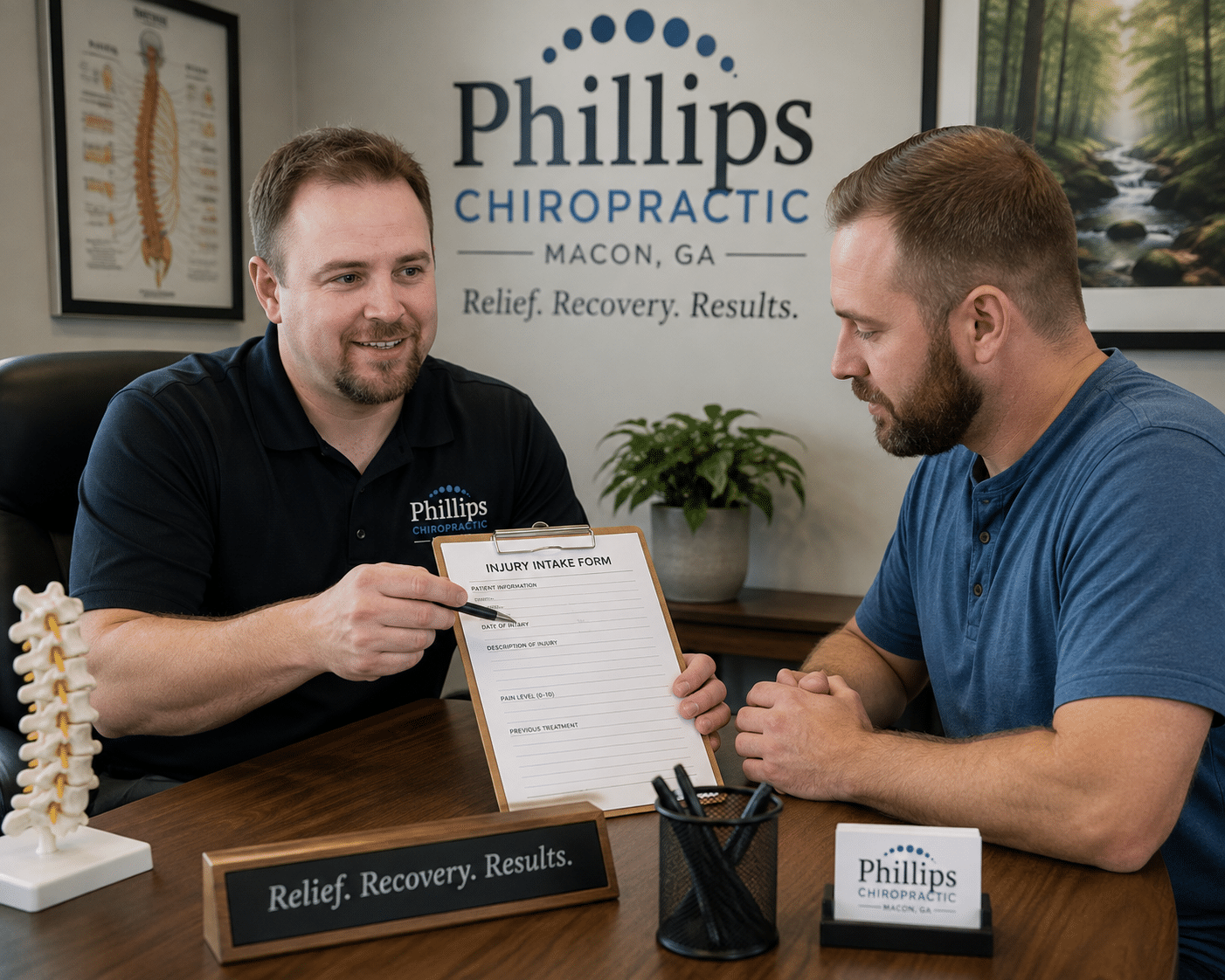
We start with a careful examination to identify all your injuries — including the subtle soft-tissue and spinal problems that are easy to miss but often cause the most lingering pain. Getting a complete picture is the foundation of both good care and solid documentation.
Drug-free, conservative treatment
Chiropractic care addresses accident injuries by restoring proper motion to injured joints, easing muscle tension, and supporting the body’s natural healing — without leaning first on medication or surgery. For many accident-related musculoskeletal injuries, this conservative approach is a sensible, recommended starting point.
Detailed documentation
Throughout your care, we document your injuries, treatment, and progress in clear, objective records. If your case involves an attorney or an insurance claim, this documentation is often essential.
A personalized recovery plan
Your plan is built around your specific injuries and may combine adjustments, soft-tissue therapy, therapeutic exercises, and guidance to help you heal fully and reduce the risk of lingering problems.
Working With Attorneys and Liens
If you’re working with a personal injury attorney, coordinated care makes everything smoother. At Phillips Chiropractic, we’re experienced in working with attorneys and we accept attorney liens — meaning, in qualifying cases, you may be able to receive the care you need now and handle payment as part of your settlement later. This can be a lifeline when you’re injured and worried about how to afford treatment.
The American Chiropractic Association recognizes chiropractic care as an established option for treating musculoskeletal injuries, and our clear documentation helps your legal team build an accurate picture of your injuries and recovery.
What to Do After an Accident
- Seek emergency care for any serious or life-threatening injuries immediately.
- Get evaluated promptly — even if you feel “fine,” within a few days at most.
- Document everything — photos, the other party’s information, witness details, and how you feel.
- Report the accident to the appropriate parties and your insurer.
- Follow your treatment plan consistently to avoid gaps in care.
- Consider legal guidance if someone else’s negligence caused your injuries.
Frequently Asked Questions About Personal Injury Chiropractic Care
Do I need an attorney to see a personal injury chiropractor? No. You can come to us directly for evaluation and care. If you do have an attorney, we’re glad to coordinate and provide the documentation your case needs.
What if I feel fine after my accident? It’s very common to feel okay at first and develop symptoms days later, once the adrenaline wears off. A prompt evaluation catches hidden injuries early — which is better for both your health and your claim.
How does an attorney lien work? In qualifying cases, an attorney lien lets you receive treatment now with payment handled as part of your settlement later. We’ll explain how it works for your situation.
Will chiropractic records really help my case? Objective, detailed documentation of your injuries and recovery is often a key part of a personal injury claim. It’s one of the most valuable things a personal injury chiropractor provides.
Do you accept insurance too? Yes — most insurance plans, including VA benefits, along with attorney liens. We’ll help you understand your options.
Injured in an Accident? We’re Here to Help
You focus on healing — we’ll handle the careful evaluation, treatment, and documentation that support both your recovery and your case. Phillips Chiropractic proudly serves Macon, Gray, Forsyth, Warner Robins, and the surrounding Middle Georgia communities, and we work with attorneys and accept liens.
Recently injured? Contact us today to schedule your evaluation or call (478) 475-4131. The sooner we see you, the better — for your health and your claim.
Uncategorized
Joint Pain Relief in Macon, GA: How Chiropractic Care Helps You Move Freely Again
7th August 2026
Aching knees on the stairs. A shoulder that won’t reach the top shelf. Hips that protest every time you get up from the couch. Joint pain has a way of shrinking your world, one avoided activity at a time. If stiff, painful joints are holding you back in Macon, GA, there’s good news: you don’t have to accept it as “just getting older.” At Phillips Chiropractic, we’ve helped Middle Georgia patients ease joint pain and move more freely for over 20 years.
This guide covers what causes joint pain, why it tends to get worse over time if ignored, and how a conservative, drug-free chiropractic approach can help you get back to living without every step being a negotiation.
Understanding Joint Pain
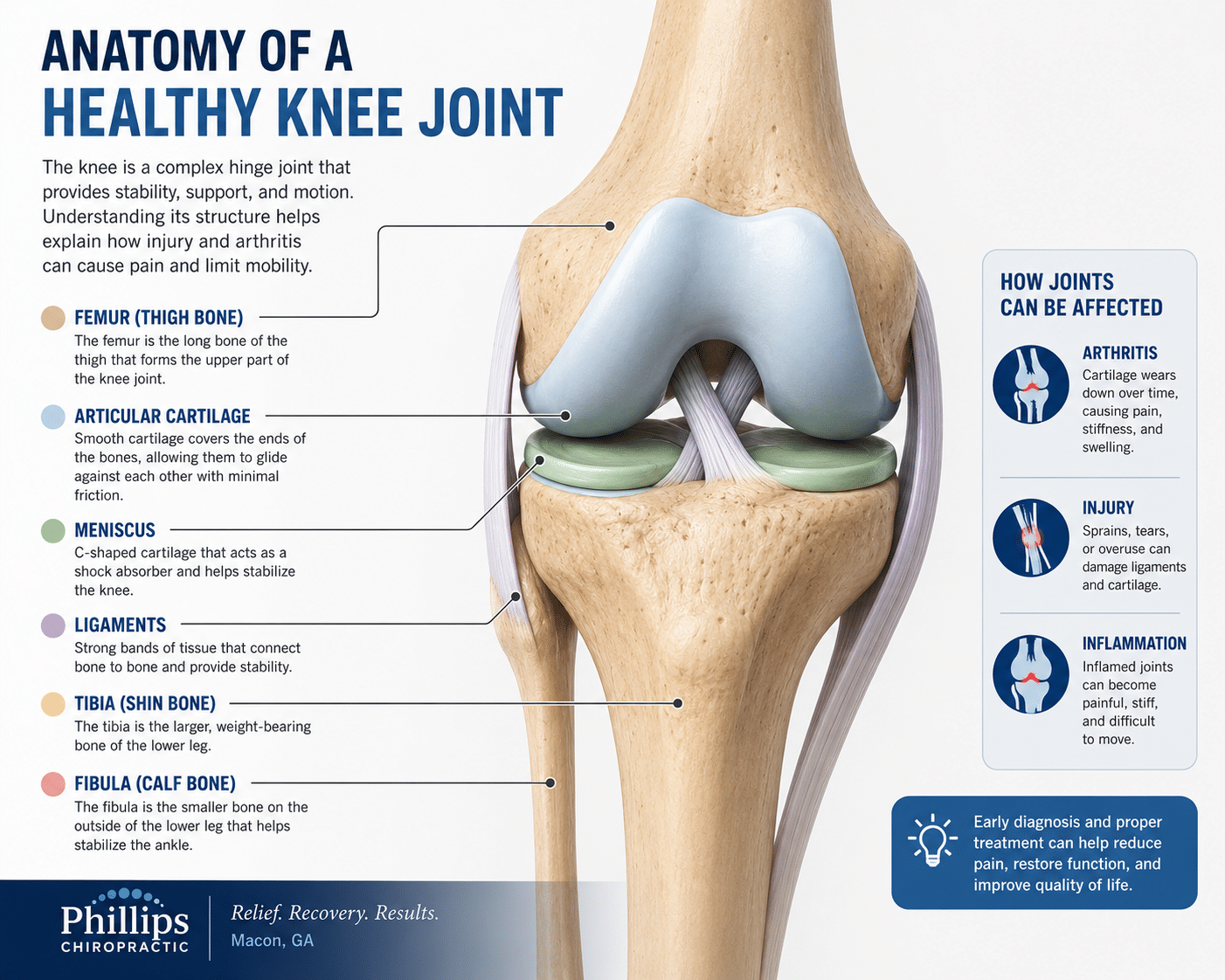
A joint is where two bones meet, cushioned by cartilage and supported by ligaments, tendons, and muscles. When everything is healthy, joints move smoothly and painlessly. Joint pain happens when something in that system is irritated, inflamed, worn, or misaligned — and because we have joints throughout the body, joint pain can show up almost anywhere.
The most common places we see joint pain at our Macon clinic include:
- Knees — from arthritis, overuse, or old injuries
- Shoulders — often from rotator-cuff issues, poor posture, or repetitive strain
- Hips — frequently arthritis-related, affecting walking and sleep
- Hands and wrists — including arthritis and repetitive-stress problems
- Spine — the facet joints of the neck and back, a major source of chronic stiffness
What Causes Joint Pain?
Osteoarthritis and “wear and tear”
The most common cause of chronic joint pain is osteoarthritis — the gradual breakdown of the cartilage that cushions your joints. As that cushioning wears thin, bones move less smoothly, and the joint becomes stiff, achy, and inflamed. The Arthritis Foundation notes that osteoarthritis is extremely common, especially as we age, and that staying active and maintaining joint mobility are key parts of managing it.
Injuries and overuse
Old sports injuries, work injuries, and years of repetitive motion can all leave joints painful and prone to flare-ups. Sometimes the original injury healed but altered how the joint moves, leading to ongoing irritation. If your pain traces back to an injury, our guide to sports injuries may also be helpful.
Poor alignment and movement patterns
Here’s something many people don’t realize: a joint problem in one area often starts somewhere else. If your spine, pelvis, or a nearby joint isn’t moving properly, it changes how forces travel through your body, overloading other joints. That’s why a knee or hip problem sometimes traces back to alignment issues elsewhere — and why a whole-body assessment matters.
Inflammatory conditions
Some joint pain stems from inflammatory or autoimmune conditions like rheumatoid arthritis, which require medical management. Part of a good evaluation is recognizing when joint pain needs a physician’s involvement — and we’ll always point you in the right direction when that’s the case.
Image suggestion: An older adult walking comfortably outdoors, smiling — conveying restored mobility. Alt text: “Active senior enjoying pain-free movement after joint pain treatment in Macon.”
How Chiropractic Care Helps With Joint Pain
Chiropractic care is well known for spinal health, but chiropractors are trained to work with joints throughout the body — including the knees, shoulders, hips, and extremities. Here’s how care may help.
Restoring proper joint motion
When a joint isn’t moving through its full, natural range, it gets stiff and irritated. Careful adjustments and mobilizations help restore that motion, which can reduce pain, improve flexibility, and slow the “stiffening” cycle that makes joints hurt more over time.
Reducing stress on painful joints
Because your body is an interconnected system, improving alignment and motion in the spine and pelvis can take excess load off painful knees and hips. Addressing the whole movement chain — not just the spot that hurts — is often the key to lasting relief.
Calming inflammation and muscle tension
Restricted joints are usually surrounded by tight, guarding muscles. Soft-tissue therapy and improved joint motion help ease that tension and support healthier circulation around the joint.
A personalized plan to keep you moving
At Phillips Chiropractic, your joint-pain plan is tailored to your body and goals. It may include spinal and extremity adjustments, soft-tissue therapy, targeted strengthening and mobility exercises, and practical guidance on activity, footwear, and daily movement. For arthritis-related pain, we can’t reverse the wear on a joint — but we can often meaningfully improve how it moves and how much it hurts, which is what matters for your daily life. Many patients also benefit from our wellness care approach to stay ahead of flare-ups.
When to Seek Help for Joint Pain
Don’t wait until you can barely move. Consider getting evaluated if you have:
- Joint pain lasting more than a couple of weeks
- Stiffness that’s worse in the morning or after sitting
- Pain that’s limiting your activities, work, or sleep
- Swelling, reduced range of motion, or a joint that “catches”
- Pain that keeps coming back despite rest
Early, conservative care often prevents small problems from becoming big ones. The longer a joint moves poorly, the more the surrounding tissues adapt around the dysfunction — so addressing it sooner is usually easier and more effective.
Frequently Asked Questions About Joint Pain
Can a chiropractor help with arthritis pain? Often, yes. While chiropractic care can’t reverse cartilage loss, improving joint motion and reducing the muscle tension around an arthritic joint can lower pain and improve function for many patients. It’s a conservative, drug-free option worth considering.
Do chiropractors only treat the spine? No. Chiropractors are trained to evaluate and treat joints throughout the body, including knees, shoulders, hips, wrists, and ankles — and often the spine and the painful joint together, since they’re connected.
Is chiropractic treatment for joints safe? For most people, it’s a safe, gentle option. Dr. Phillips reviews your history and tailors techniques to your joints and comfort level. If your joint pain points to a condition that needs medical care, we’ll tell you.
How soon will I feel better? It depends on the cause and how long you’ve had the problem. Some patients feel relief quickly; chronic, arthritis-related pain is usually managed over time. We’ll give you a realistic timeline at your evaluation.
Do you accept insurance for joint pain visits? Yes — most insurance plans, including VA benefits, and same-day appointments when available.
Move Freely Again — Schedule Your Visit in Macon
Life’s better when your body cooperates. Whether it’s a stiff knee, an achy shoulder, or hips that make you dread the stairs, Phillips Chiropractic can help you move more comfortably and get back to the activities you’ve been avoiding. We serve Macon, Gray, Forsyth, Warner Robins, and the surrounding Middle Georgia communities, and we accept most insurance.
Ready to take the load off your joints? Contact us today to schedule an appointment or call (478) 475-4131. Let’s get you moving freely again.